Identify aromatic polyamide-imide fibers using FTIR, dissolution, microscopy, and combustion. Compare with meta-aramid, para-aramid, and P84 fibers.
Identification of Aromatic Polyamide-Imide Fibers
Abstract
Aromatic polyamide-imide fibers were identified using combustion, microscopy, dissolution, and infrared spectroscopy. They were compared with meta-aramid, para-aramid, and P84 fibers, which have similar properties. Aromatic polyamide-imide fibers emit red light when burned, have a circular cross-section, and dissolve in N,N-dimethylformamide at room temperature. Their infrared absorption spectrum exhibits characteristic frequencies. Accurate identification of this fiber can be achieved by utilizing one or more of these characteristics.
0 Introduction
Aromatic polyamide fibers can be classified according to their molecular structure into: aromatic polyamide fibers bonded by amide groups, typically represented by meta-aramid fibers (
meta-aramid) and para-aramid fibers (para-aramid); aromatic polyimide fibers bonded by imide groups, such as polyphenylenetetramethylimide fibers and
polyimide fibers (P84); and polyamide-imide fibers composed of alternating amide and imide groups.
Currently, corresponding identification standards have been established for some aromatic polyamide fibers. Appendix A of GB/T 41418—2022, "Quantitative Chemical Analysis of Textiles—Mixtures of Meta-aramid and Para-aramid Fibers (Lithium Chloride/N,N-Dimethylacetamide Method)," clearly provides identification methods for meta-aramid and para-aramid fibers; Appendix A of GB/T 36976—2018, "Quantitative Chemical Analysis of Textiles—Mixtures of Polyimide Fibers and Certain Other Fibers," records the identification method for P84. However, there is currently no specific identification method for aromatic polyamide-imide fibers.
This paper uses the combustion method, microscopy, dissolution method, and infrared spectroscopy to qualitatively analyze aromatic polyamide-imide fibers, and compares them with structurally similar meta-aramid, para-aramid, and P84, forming a complete identification method for aromatic polyamide-imide fibers, providing a basis for routine testing.
1. Experimental Section
1.1 Reagents and Instruments
Reagents: Liquid paraffin, sulfuric acid (analytical grade, 70%), concentrated sulfuric acid (analytical grade, 95%~98%), concentrated nitric acid (analytical grade, 65%~68%), sodium hypochlorite (chemically pure), sodium hydroxide (analytical grade, 30%), dimethyl sulfoxide (analytical grade, ≥99.5%), potassium thiocyanate (analytical grade, ≥98.5%), N,N-dimethylformamide (analytical grade, ≥99.5%), potassium bromide [spectrally pure, 99.99%].
Instruments: E5723 CU-6 fiber fineness analyzer, Nicolet Summit Lite Fourier transform infrared spectrometer, 2XZ-4D vacuum pump, constant temperature water bath shaker, glass frit crucible, Erlenmeyer flask, Soxhlet extractor, graduated cylinder, beaker, Hastelloy slicer.
1.2 Sample Preparation
Aromatic polyamide-imide fiber, meta-aramid, para-aramid, and P84 loose fiber were selected as test objects. To ensure the accuracy and reliability of the test data, four samples were selected for each fiber using a multi-point sampling method.
1.3 Test Methods
1.3.1 Combustion Method
According to the test requirements of relevant standards, the samples were observed and recorded as follows: When the sample was brought close to the flame, its reaction to heat was observed, noting whether there was shrinkage or melting; during the sample's contact with the flame, its combustion state was recorded, including whether it emitted light and the color of the flame; after the sample was removed from the flame, the combustion situation was continuously observed; when the flame of the sample was extinguished, its odor was smelled; after the sample cooled, the state of the residue was recorded, including its color and shape.
1.3.2 Microscopy Method
According to relevant standards, fiber bundles were first taken, and an appropriate amount of fiber segments were cut using a Hartsch microtome. Liquid paraffin was dropped onto a glass slide to distribute the fibers evenly, thus preparing a longitudinal glass slide. Subsequently, collodion was applied to a Hartsch microtome. After evaporation, fiber sections with a thickness of 10–30 μm were cut using the microtome, thus preparing cross-sectional slides. Finally, the prepared longitudinal and cross-sectional slides were placed under a microscope at 500x magnification to carefully observe the morphological characteristics of the fiber cross-sections and record the findings.
1.3.3 Dissolution Method
Following relevant standard requirements, samples and reagents were placed at a 1:50 ratio under different environmental conditions for observation. One group was kept at room temperature (20–30°C) with continuous shaking for 5 minutes, and the dissolution of the fibers during this period was carefully observed and recorded. The other group was boiled, with the solution kept boiling for 3 minutes, and the dissolution of the fibers during this process was monitored and recorded promptly.
1.3.4 Infrared Spectroscopy
According to relevant standards, sample films were prepared using the potassium bromide pellet method. Fourier transform infrared spectroscopy was used to scan and record the infrared spectrum in the wavenumber range of 4000–400 cm⁻¹.
2 Results and Discussion
2.1 Combustion Test Results
The combustion test records for four fibers—aromatic polyamide-imide fiber, meta-aramid, para-aramid, and P84—are shown in Table 1.
As shown in Table 1, aromatic polyamide-imide fiber emits a red flame during combustion, leaving a black, hard residue after combustion. This combustion behavior is very similar to that of para-aramid and P84, while meta-aramid does not exhibit a red flame during combustion. Based on this characteristic, the combustion method can effectively distinguish aromatic polyamide-imide fiber from meta-aramid.
2.2 Microscopic Test Results
The cross-sectional and longitudinal morphological descriptions of the four fibers are shown in Table 2.
Referring to the morphological descriptions of the four fibers in Table 2, it can be seen that the cross-section of aromatic polyamide-imide fibers is circular. This characteristic is similar to that of meta-aramid and para-aramid fibers, while the cross-section of P84 fibers is trilobal, which is significantly different from that of aromatic polyamide-imide fibers. In terms of longitudinal morphology, aromatic polyamide-imide fibers exhibit the smooth surface characteristic common to chemical fibers, while para-aramid fibers show a visible segmented morphology in their longitudinal section. Therefore, by observing the longitudinal morphology, aromatic polyamide-imide fibers can be distinguished from para-aramid fibers.
In summary, careful observation of the cross-section and longitudinal morphology of the fibers using a microscope can clearly distinguish aromatic polyamide-imide fibers from para-aramid and P84 fibers.
2.3 Results of the Dissolution Test
The dissolution properties of the four fibers are shown in Table 3.
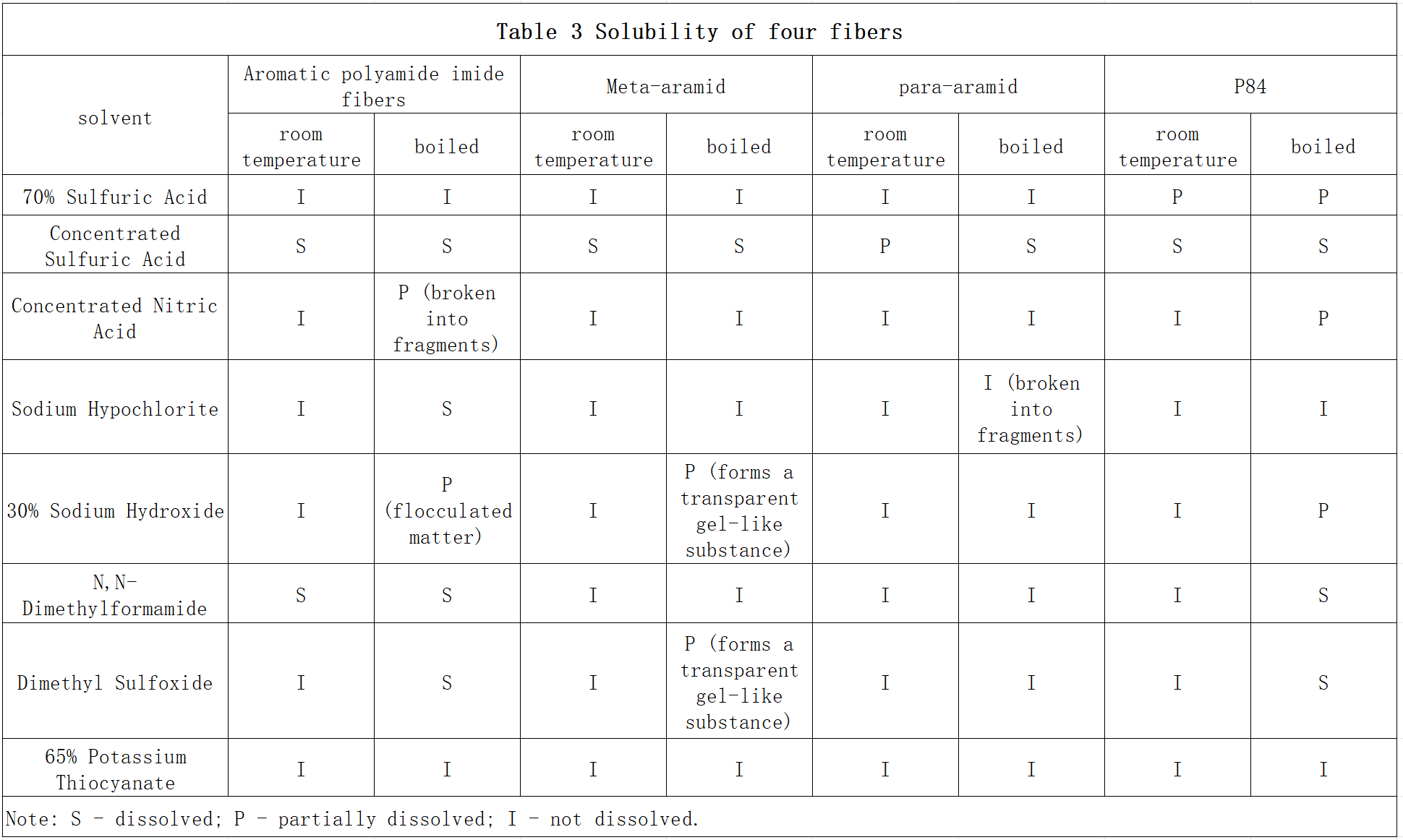
Table 3 shows the solubility of the four fibers. Under room temperature and boiling conditions, tests were conducted using 70% sulfuric acid, concentrated sulfuric acid, concentrated nitric acid, 30% sodium hydroxide, and 65% potassium thiocyanate. The solubility performance of the aromatic polyamide-imide fiber, meta-aramid, para-aramid, and P84 fibers showed little difference. Under 70% sulfuric acid conditions, P84 partially dissolved, while the other three fibers did not. In concentrated sulfuric acid, aromatic polyamide-imide fiber, meta-aramid, and P84 all dissolved, while only para-aramid partially dissolved at room temperature. In concentrated nitric acid, almost all four fibers did not dissolve, with only aromatic polyamide-imide fiber and P84 partially dissolving under boiling conditions. The situation was similar with 30% sodium hydroxide; aromatic polyamide-imide fiber, meta-aramid, and P84 only partially dissolved upon boiling. Under 65% potassium thiocyanate conditions, none of the four fibers dissolved.
Under sodium hypochlorite conditions, all four fibers are insoluble at room temperature. However, when boiled, the aromatic polyamide-imide fiber dissolves, while the other three fibers remain insoluble. This solubility characteristic can be used to distinguish the aromatic polyamide-imide fiber from the other three fibers. In N,N-dimethylformamide, the difference in solubility among the four fibers is even more pronounced. The aromatic polyamide-imide fiber dissolves at room temperature, a test condition that is easily achieved and readily distinguishes it from other fibers. Under dimethyl sulfoxide conditions at room temperature, all four fibers are insoluble. When boiled, the aromatic polyamide-imide fiber and P84 dissolve. This solubility property can be used to distinguish the aromatic polyamide-imide fiber from meta-aramid and para-aramid fibers.
Dimethyl sulfoxide (DMSO) can be used to distinguish aromatic polyamide-imide fibers from meta-aramid and para-aramid fibers via a dissolution method. N,N-dimethylformamide (NDM) and sodium hypochlorite (NSC) can distinguish aromatic polyamide-imide fibers from meta-aramid, para-aramid, and P84 fibers. NDM, in particular, is simple to operate and the experimental conditions are easy to achieve.
2.4 Infrared Spectroscopy Results
The main absorption bands and characteristic frequencies of the infrared absorption spectra of the four fibers are shown in Table 4.
In Table 4, the infrared absorption peaks of aromatic polyamide-imide fibers appear at 3379, 2923, 1704, 1505, 1361, 1081, and 719 cm⁻¹. This spectral characteristic is significantly different from that of meta-aramid, para-aramid, and P84 fibers. Especially compared to P84 fibers, the difference is very obvious and easily distinguishable. Based on this, infrared spectroscopy can not only accurately identify aromatic polyamide-imide fibers, but also easily distinguish them from the other three types of fibers.
3. Conclusions
(1) Combustion and Microscopy: The combustion method can effectively distinguish aromatic polyamide-imide fibers from meta-aramid fibers; while microscopy can be used to distinguish aromatic polyamide-imide fibers from para-aramid fibers and P84. Combining the combustion and microscopy methods can further distinguish aromatic polyamide-imide fibers from meta-aramid fibers, para-aramid fibers, and P84.
(2) Dissolution Method: Sodium hypochlorite and N,N-dimethylformamide can be used to distinguish aromatic polyamide-imide fibers from meta-aramid fibers, para-aramid fibers, and P84; dimethyl sulfoxide can be used to distinguish aromatic polyamide-imide fibers from meta-aramid fibers and para-aramid fibers. Among these solvents, N,N-dimethylformamide is the simplest and most convenient method for identifying aromatic polyamide-imide fibers, and it has high feasibility in practical applications.
(3) Infrared Spectroscopy: Infrared spectroscopy can distinguish aromatic polyamide-imide fibers from meta-aramid, para-aramid, and P84. By analyzing the characteristic peak positions in the infrared absorption spectrum, aromatic polyamide-imide fibers can be accurately identified, making it a highly effective identification method.
Based on the above experimental results, aromatic polyamide-imide fibers can be identified based on several significant characteristics: they emit red light when burned; their cross-section is circular under a microscope; they are soluble in N,N-dimethylformamide at room temperature; and they possess specific characteristic frequencies in their infrared absorption spectrum. In practical identification, we can rely on one of these characteristics or flexibly combine multiple characteristics to achieve more accurate and reliable identification.


