Compare para-aramid, heterocyclic aramid and PBO stab-resistant materials under GA 68-2024 and NIJ 0115.00, including blade, resin and heat effects.
Institute of Non-metallic Materials: Comparative Analysis of Stab Resistance of High-Performance Fiber/Resin-Based Materials Under Domestic and International Standards
Comparison of Stab Resistance of High-Performance Fiber/Resin-Based Materials Under Domestic and International Standards
Abstract: This paper investigates the differences in stab resistance among various high-performance fiber/resin-based materials by comparing test results obtained under China’s *GA 68-2024 Police Stab-Resistant Vests* standard and the US standard *NIJ 0115.00-2000 Stab Resistance of Personal Body Armor*. It also analyzes the characteristics of evaluation metrics and the specific material performance requirements emphasized by these domestic and international standards. Stab resistance was assessed by calculating the number of layers and the areal density of materials required to meet specific protection levels. The results indicate that for high-performance fiber/resin-based materials, stab resistance improves with higher fiber strength when resin content is similar, and improves with higher resin content when fiber strength is similar. Meeting the Class A requirement of the GA 68 standard necessitates more than double the material required for Class B, and the D2 blade in the GA 68 standard is more potent than the D3 blade. Under the NIJ 0115.00 standard, the S1 blade is relatively less potent; the P1 blade places high demands on fiber strength, while the spike blade places high demands on resin content. High-temperature conditions have the most significant impact on resin-based stab-resistant materials; therefore, high-temperature stab resistance is a key focus when testing samples against the GA 68 standard.
Keywords: Stab resistance; high-performance fiber; stab resistance standard; stab-resistant material; areal density
The evolution of stab-resistant materials for body armor has progressed through three stages: rigid materials, semi-rigid materials, and soft materials. Currently, the soft stab-resistant materials commonly used domestically and internationally are high-performance fiber/resin-based composites. Stab-resistant vests made from these materials have superseded rigid and semi-rigid options due to their superior wearing comfort and reduced risk of causing secondary injuries [1-7].
Aramid fibers (including para-aramid and heterocyclic aramid), poly(p-phenylene benzobisoxazole)
(PBO) fibers, ultra-high molecular weight polyethylene
(UHMW-PE) fibers, and
carbon fibers are currently the primary high-performance fibers. UHMW-PE fibers possess low surface polarity, whereas the reinforcing resins used to impregnate them exhibit high surface polarity; this mismatch results in weak interfacial bonding, rendering UHMW-PE fibers unsuitable for the fabrication of resin-based stab-resistant materials [8-10]. Although carbon fibers offer high tensile strength and modulus, their low fracture toughness limits energy absorption, and they are rarely used in isolation for protective applications. Consequently, aromatic fibers such as aramid and PBO are the predominant high-performance fibers employed in resin-based stab-resistant materials [11-14].
To evaluate the stab resistance of protective materials, countries such as the United States, the United Kingdom, and Germany have established relevant standards for stab-resistant body armor. The most influential of these is "Stab Resistance of Personal Body Armor" (NIJ Standard 0115.00-2000), issued by the National Institute of Justice (NIJ) under the U.S. Department of Justice, which is widely adopted globally. my country has also established its own standard for stab-resistant body armor, "GA 68-2024 Police Stab-Resistant Body Armor," formulated by the Ministry of Public Security.
This paper presents a systematic comparison and evaluation of the stab-resistance performance of these high-performance fiber/resin composite materials against both Chinese and U.S. standards. Furthermore, it analyzes the characteristics and focal points of domestic and international standards regarding testing methods, evaluation metrics, and material performance requirements.
1 Experimental Section
1.1 Main Raw MaterialsStandard-strength para-aramid fiber fabric: TH5108 (fiber tensile strength: 21.5 cN/dtex), self-made;
High-strength para-aramid fiber fabric: TH61081 (fiber tensile strength: 23.5 cN/dtex), self-made;
Heterocyclic aramid fiber fabric: F-3P200 (fiber tensile strength: 28 cN/dtex), self-made;
PBO fiber fabric: JQZW SP200-1100 (fiber tensile strength: 28 cN/dtex), self-made;
Epoxy resin and modified aliphatic amine: self-made.
1.2 Main Instruments and EquipmentGA68 stab resistance tester: MPFCT-2000, Shanghai Shenghe Textile Technology Co., Ltd.;
NIJ stab resistance tester: AQJL-300, Shanghai Shenghe Textile Technology Co., Ltd.;
GA68 test blades: D1, D2, D3, Shanghai Shenghe Textile Technology Co., Ltd.;
NIJ test blades: P1, S1, Spike, Shanghai Shenghe Textile Technology Co., Ltd.
1.3 Sample PreparationDue to differences in compatibility between various high-performance fibers and the epoxy resin, slight variations in the areal density of the prepared stab-resistant materials occur after resin coating and curing, even when the initial fabric areal density is identical [15-18]. To ensure the scientific validity and rigor of the test results, four types of high-performance fiber fabrics—standard-strength para-aramid, high-strength para-aramid, heterocyclic aramid, and PBO—were selected, all with an areal density of 200 g/m².
The stab-resistant materials were prepared using a manual resin coating process. Several samples measuring 350 mm × 300 mm were cut from the four types of high-performance fiber fabrics mentioned above. Epoxy resin was applied to both sides of the fabrics using a scraper, followed by post-curing in an autoclave at 120°C and a molding pressure of 0.3 MPa for 4 hours. Six types of high-performance fiber/resin-matrix stab-resistant composite materials were thus prepared. Among them, samples 1# through 3# utilized the same fiber type—standard-strength para-aramid fiber fabric—but featured progressively increasing resin content; samples 3# through 6# utilized different fiber types but had similar resin contents. The basic parameters of the stab-resistant material samples are listed in Table 1. To prepare the stab-resistant layers for testing, the materials were stacked and sealed within a black waterproof fabric; this covering effectively protected the materials from light, moisture, and contaminants, ensuring testing accuracy. The areal density values reported for the samples in subsequent tests refer to the stab-resistant material itself, excluding the waterproof fabric.
Table 1 Parameters of the prepared stab-resistant materials

1.4 Testing and CharacterizationThe stab-resistant layer samples were tested in accordance with the GA 68 and NIJ 0115.00 standards; a comparison of these two standards is provided in Table 2. The GA 68 standard comprises two levels—Class A and Class B—both requiring a puncture energy of 24 J with no penetration allowed during testing. Class A is intended for general environments and involves only one type of blade. Class B is specifically designed for aviation environments, where the likelihood of encountering extremely sharp blades is minimal; consequently, the sharpness specifications for the D2 and D3 blades in Class B are reduced.
Table 2 Comparison of GA 68 and NIJ 0115.00
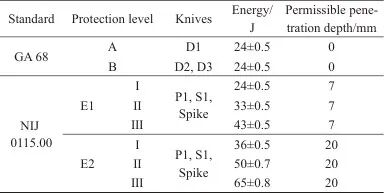
Note: E1 and E2 represent two energy levels of stab-resistant test in NIJ 0115.00.
NIJ 0115.00 is divided into three protection levels. Each level requires passing tests with three types of blades (P1 blade, S1 blade, and spike). Furthermore, each level involves two energy tiers: the maximum allowable penetration is 7 mm for low-energy tests and 20 mm for high-energy tests.
The structure and operating principles of the testing equipment for GA 68 and NIJ 0115.00 are identical; Figure 1 shows a schematic of the stab-resistance testing equipment, and Figure 2 shows the test blades. The stab-resistant layer is placed on the backing material on the test platform. The test blade, mounted on a test assembly, penetrates the stab-resistant layer via free fall. A velocity measurement zone captures the blade's free-fall speed to calculate the test energy; the test is considered valid if the energy meets the standard's requirements.
Figure 1 Schematic of stab-resistance testing equipment
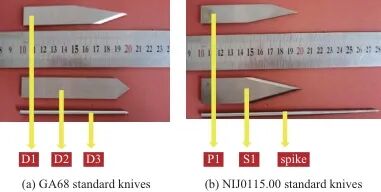
Figure 2 Test blades for stab-resistance testing
2 Results and Discussion
2.1 Comparison of stab-resistance performance of different materials under different standardsStab-resistance tests were conducted on the six materials listed in Table 1 under ambient temperature conditions. Five sets of samples were tested for each configuration, and the results represent the average of these five sets. At a given protection level, a material requiring fewer layers—and thus having a lower overall areal density—demonstrates superior stab-resistance performance; conversely, a material requiring more layers—and thus having a higher overall areal density—demonstrates inferior performance. Table 3 compares the stab-resistance performance of the different materials under the various standards. For GA 68 Class A and Class B, the test energy was 24 J. For NIJ 0115.00 Levels I, II, and III, tests were conducted at the corresponding E1 and E2 energy levels as required by the standard; the reported result is the maximum areal density required to satisfy both energy levels simultaneously.
Table 3 Comparison of stab resistance performance of different materials under various standards
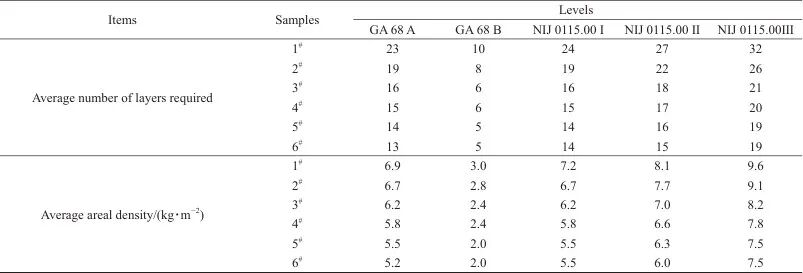
(1) Under the same level of stab resistance standards, among materials 3#, 4#, 5#, and 6# (which have similar resin contents), the 6# PBO material has the lowest areal density, while the 3# para-aramid material has the highest; thus, the 6# PBO material exhibits the best stab resistance. This indicates that for resin-based stab-resistant materials with the same resin content, higher fiber strength results in better stab resistance. (2) Under the same standard level and using the same type of fiber fabric, the areal densities of materials 1#, 2#, and 3# increase progressively. This indicates that for resin-based materials using the same fiber, higher resin content results in better stab resistance. (3) Although both GA 68 Class A and Class B tests involve stabbing with an energy of 24 J, the sharpness of the blades differs, with the Class B blade being less potent; the areal density required to protect against the Class A blade is more than double that required for the Class B blade, demonstrating that the Class B blade in the GA 68 standard has less than half the potency of the Class A blade. For the NIJ 0115.00 standard, the stabbing energy increases across the three levels; consequently, the number of layers and the areal density of the material required to provide protection also increase progressively. (4) The areal densities required to protect against GA 68 Class A and NIJ 0115.00 Level I are similar; the GA 68 Class A test involves 24 J of energy with zero penetration allowed, whereas the NIJ 0115.00 standard involves 24 J for the low-energy level (allowing 7 mm penetration) and 33 J for the high-energy level (allowing 20 mm penetration), implying that these two protection levels impose comparable demands on resin-based stab-resistant materials.
2.2 Comparison of Stab Resistance of Different Materials Against Various Test BladesThe severity of the threat posed by different blade types—two from the GA 68 Class B standard and three from the NIJ 0115.00 standard—was investigated at equivalent energy levels. When evaluating whether a material meets stab resistance standards, the most potent blade specified in the standard is typically the deciding factor; if a sample can withstand the most powerful blade, it can be inferred that it meets the standard for that protection level. Since different blades impose distinct demands on the material, analyzing performance variations across different blades reveals the material's specific characteristics. Various stab-resistant materials were tested against the two GA 68 Class B blades and the three NIJ 0115.00 blades. Table 4 lists the number of material layers and the areal density required for the materials to meet the corresponding GA 68 Class B and NIJ 0115.00 Level I standards.
Table 4 Comparison of stab resistance performance of different materials against various test blades
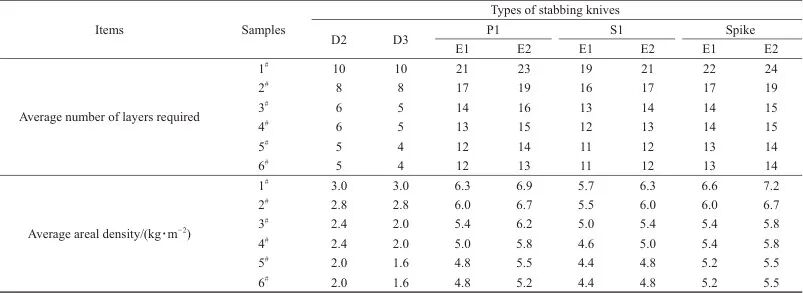
As shown in Table 4: (1) Regarding the two GA 68 Class B blades used on high-performance fiber-reinforced resin-matrix stab-resistant materials, defending against the D3 blade requires more material than defending against the D2 blade, indicating that the D3 blade poses a greater threat. Consequently, during preliminary stab resistance testing, if a material with a specific areal density can withstand the D2 blade, it can generally be inferred that the material—at that areal density—is capable of passing the GA 68 Class B test. (2) Across the three NIJ 0115.00 levels, the areal density required for high-energy tests (allowing 20 mm penetration) is consistently higher than that required for low-energy tests (allowing 7 mm penetration). Therefore, during preliminary testing, if a material with a specific areal density can withstand the high-energy test for a given NIJ 0115.00 level, it can be determined that the material meets the standard for that level, eliminating the need for additional low-energy testing at the same level. (3) Among the three blade types specified in NIJ 0115.00, the S1 blade requires the lowest areal density of high-performance fiber-reinforced resin-matrix stab-resistant material for protection, indicating that the S1 blade is the least formidable. The P1 blade in NIJ 0115.00 is analogous to the D1 blade in domestic public security standards; it features a relatively long and wide blade, exerts a stronger shearing action on the material during penetration, and places higher demands on the mechanical properties of the fibers. Consequently, materials with higher fiber strength offer superior protection against the P1 blade. Among samples #3, #4, #5, and #6—which share comparable resin content—sample #6 exhibits the best mechanical properties and thus requires a lower areal density to protect against the P1 blade. The "spike" blade in NIJ 0115.00 is sharp and slender; under high-speed downward impact, it easily slips past fiber constraints, minimizing the shearing of fiber bundles and failing to effectively dissipate the blade's kinetic energy, which allows it to continue penetrating downward. Therefore, when defending against this type of blade, the material's resin content and resin hardness become critical factors. Among samples #1, #2, and #3—which utilize the same fiber type but differ in resin content—sample #3 demonstrates a more pronounced advantage in protecting against the spike blade compared to the other blade types. Furthermore, Table 4 shows that for samples #3, #4, #5, and #6—which vary in fiber strength but have comparable resin content—there is no significant difference in protection against the spike blade, further confirming that the spike blade places higher demands on the resin content of stab-resistant materials.
2.3 Comparison of stab resistance of different materials under various environmental conditionsmy country's stab-resistance standard, GA 68, provides detailed specifications regarding the environmental adaptability of stab-resistant vests, covering three conditions: high temperature, low temperature, and water immersion. High-temperature testing involves conditioning the sample at (55 ± 2)°C for 4 hours prior to the stab test; low-temperature testing involves conditioning at (-20 ± 2)°C for 4 hours; and water immersion testing involves soaking the stab-resistant layer sample in water for 30 minutes before removing it for the stab test. Table 5 lists the number of layers and the areal density required for various stab-resistant materials when tested under different environmental conditions.
Table 5: Comparison of stab-resistance performance of different materials under various environmental conditions
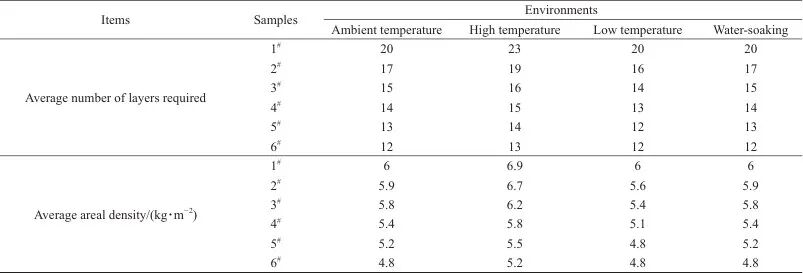
As shown in Table 5, high-performance fiber/resin-matrix stab-resistant materials require a higher areal density under high-temperature conditions. In contrast, the required number of layers and areal density remain essentially the same under water-immersion and ambient-temperature conditions. Furthermore, the lowest number of layers and the lowest areal density are required under low-temperature conditions. This is because resin hardness decreases at high temperatures, and hardness is a key factor influencing the stab-resistance performance of these materials. Reduced hardness weakens the stab-resistant layer's ability to blunt the tip of a blade, thereby diminishing stab-resistance performance. Conversely, resin hardness increases in low-temperature environments, resulting in superior stab-resistance performance for the materials. Results from the water-immersion tests indicate that when manufacturing stab-resistant vests, provided the waterproof fabric encapsulating the stab-resistant material meets quality standards, The puncture resistance of the material remains unaffected when immersed in water. Preliminary testing of puncture-resistant materials should prioritize evaluating performance under high-temperature conditions.
3 Conclusions
(1) For high-performance fiber/resin-matrix puncture-resistant materials, when the resin content is identical or similar, higher fiber strength results in superior puncture resistance; conversely, when fiber strength is constant, higher resin content yields better puncture resistance.
(2) The areal density of high-performance resin-matrix materials required to meet the Class A puncture resistance standard of GA 68 is more than double that required for Class B. There is a progressive relationship regarding the materials and areal densities required to meet the three protection levels of the US NIJ 0115.00 standard, with higher-energy threats at a given level being more difficult to defeat than lower-energy threats at the same level. The puncture resistance of GA 68 Class A is comparable to that of NIJ 0115.00 Level I.
(3) Regarding high-performance fiber/resin-matrix puncture-resistant materials, the D2 blade specified in GA 68 is less potent than the D3 blade. Among the NIJ 0115.00 blades, the S1 blade is the least potent; the P1 blade places high demands on the material's fiber strength, while the spike blade places high demands on the material's resin content.
(4) High-temperature environments have the most significant impact on high-performance resin-matrix puncture-resistant materials; therefore, preliminary testing should focus on puncture resistance performance under high-temperature conditions.


